
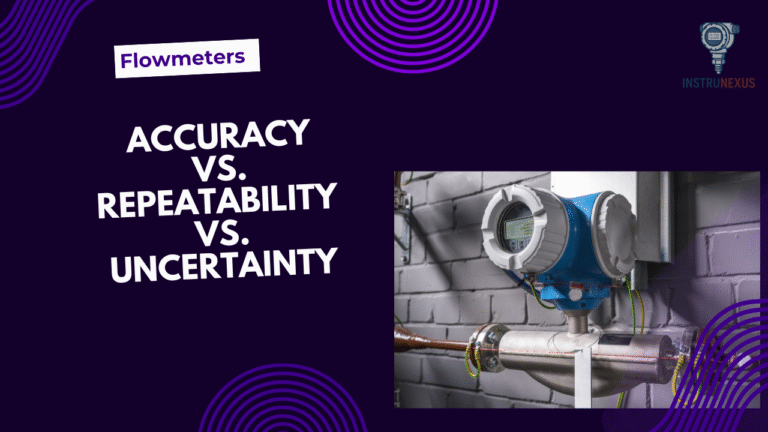
The core difference between accuracy, repeatability, and uncertainty in flow measurement is that accuracy tells you how close a measurement is to the true value, repeatability describes how close multiple measurements are to each other under the same conditions, and uncertainty provides a quantified range around a measurement where the true value is confidently expected to lie, accounting for all possible errors.
In short:
Accuracy: Closeness to the “true” value.
Repeatability: Consistency of measurements.
Uncertainty: The “doubt” in the measurement.
Decoding Flow Measurement: Accuracy vs. Repeatability vs. Uncertainty
In the world of industrial processes, from oil and gas custody transfer to food and beverage production, measuring the flow of fluids is a critical, everyday task. The data from flow meters dictates process efficiency, product quality, and financial transactions. But not all measurements are created equal. When selecting a flow meter, you’ll constantly encounter three pivotal terms: accuracy, repeatability, and uncertainty.
While often used interchangeably in casual conversation, these concepts are fundamentally different. Misunderstanding them can lead to selecting the wrong technology, resulting in process inefficiencies, financial losses, and safety risks. This comprehensive guide will demystify these terms and explore how they apply to the most common flow measuring technologies: Differential Pressure (DP), Magnetic, Ultrasonic, Vortex, and Coriolis meters.
The Three Pillars of Measurement Confidence
Before diving into specific technologies, let’s establish a clear understanding of our three core concepts. Imagine you’re shooting arrows at a target. This simple analogy will help clarify the difference.
What is Accuracy? 🎯
Accuracy is the degree of closeness between a measured value and the actual, or “true,” value of the quantity being measured. In our analogy, accuracy is how close your arrow is to the bullseye. A single arrow landing right on the bullseye is perfectly accurate.
In flow measurement, the “true” value is typically determined by a primary calibration standard at a facility like a National Metrology Institute (NMI). Accuracy is often expressed as a percentage of the measured value (percent of rate) or as a percentage of the meter’s maximum capacity (percent of full scale or % FS).
Percent of Rate: The error is proportional to the flow rate. For example, a meter with ±1% of rate accuracy will have an error of ±1 GPM at 100 GPM and ±0.1 GPM at 10 GPM. This is generally preferred as it provides a known accuracy across the operating range.
Percent of Full Scale: The error is a fixed value based on the meter’s maximum flow. For a 1000 GPM meter with ±1% FS accuracy, the potential error is always ±10 GPM, whether the flow is 1000 GPM or just 50 GPM. This makes the measurement significantly less accurate at lower flow rates.
Key Takeaway: Accuracy tells you how “correct” your measurement is in ideal conditions.
What is Repeatability? 🔄
Repeatability is the ability of a flow meter to reproduce the same result when measuring the identical flow rate multiple times under the exact same operating conditions (fluid, temperature, pressure, etc.). In our target analogy, repeatability is about grouping. If you shoot three arrows and they all land very close to each other, you have high repeatability, even if that group isn’t at the bullseye.
For many industrial processes, especially in control applications, repeatability can be more important than absolute accuracy. If a meter is consistently off by the same amount (e.g., always reads 2% high), this systematic error (or bias) can often be corrected for in the control system. The key is that the measurement is stable and predictable. An unrepeatable meter is unpredictable, making precise control impossible.
Repeatability is typically much better (a smaller percentage) than a meter’s accuracy. A meter might have an accuracy of ±0.5% but a repeatability of ±0.1%.
Key Takeaway: Repeatability tells you how consistent your measurement is.
What is Uncertainty? 🤔
Uncertainty is the most comprehensive and perhaps most misunderstood concept of the three. It is not just the meter’s accuracy specification from the manufacturer. Measurement uncertainty is a parameter that quantifies the doubt about the result of a measurement. It provides a range within which the true value is expected to lie, with a stated level of confidence (e.g., 95%).
Think of it this way: accuracy is a manufacturer’s claim under ideal lab conditions. Uncertainty is the reality of your measurement in the field. It accounts for all potential sources of error, which are broadly categorized as:
Type A errors: Those evaluated by statistical methods (e.g., the random scatter in a series of measurements, i.e., repeatability).
Type B errors: Those evaluated by other means (e.g., manufacturer’s accuracy specs, calibration certificate data, errors from environmental effects, installation issues, fluid property assumptions).
The total uncertainty budget includes contributions from:
The flow meter’s own performance (its base accuracy and repeatability).
The calibration uncertainty of the lab that tested the meter.
Installation effects (e.g., insufficient straight pipe runs, pipe roughness).
Environmental conditions (e.g., temperature and pressure fluctuations, vibration).
Fluid properties (e.g., changes in density, viscosity, or conductivity).
Errors from secondary instrumentation (e.g., pressure and temperature transmitters).
According to international standards like the ISO “Guide to the Expression of Uncertainty in Measurement” (GUM), these individual uncertainty components are combined using statistical methods (like root-sum-of-squares) to calculate the total expanded uncertainty.
Key Takeaway: Uncertainty is the “real-world” margin of error for your entire measurement system, giving a confidence level for where the true value lies.
Performance in Practice: Analyzing Flow Meter Technologies
Now let’s apply these concepts to five popular flow measurement technologies. Each has a unique operating principle that dictates its performance characteristics.
1. Differential Pressure (DP) Flow Meters
DP meters are one of the oldest and most widely used flow technologies. They operate by introducing a constriction in the pipe (like an orifice plate, venturi, or flow nozzle), which creates a pressure drop. This differential pressure, measured by a transmitter, is proportional to the square of the flow velocity.
Accuracy: The accuracy of a DP system is not just the transmitter; it’s a composite of the primary element’s quality (e.g., the precision of the orifice bore), the transmitter’s accuracy, and the accuracy of the fluid density measurement. A typical system accuracy is in the range of ±1% to ±2% of full scale. High-performance systems with precision-engineered elements and smart multi-variable transmitters can achieve better, around ±0.5% to ±0.75% of rate.
Repeatability: Repeatability is generally quite good, often around ±0.1% to ±0.2%. This makes DP meters suitable for control applications where consistency is paramount.
Uncertainty: The uncertainty of a DP meter is highly dependent on proper installation and adherence to standards (like ISO 5167). The largest uncertainty contributors are often the primary element’s discharge coefficient, pipe roughness, edge sharpness of an orifice plate, and fluid density variations. Improper installation (e.g., insufficient straight pipe) can dramatically increase uncertainty.
2. Magnetic Flow Meters (Magmeters)
Magmeters operate based on Faraday’s Law of Induction. As a conductive fluid flows through a magnetic field generated by the meter, it induces a voltage. This voltage is directly proportional to the fluid’s velocity.
Accuracy: Magmeters are known for excellent accuracy, typically ranging from ±0.2% to ±0.5% of rate. Because they measure velocity across the entire pipe diameter, they are less sensitive to flow profile distortions than many other meter types.
Repeatability: Repeatability is exceptional, often specified as ±0.1% or even better. Their stability makes them a top choice for high-precision batching and process control.
Uncertainty: The main uncertainty contributors for a magmeter are the calibration of the meter itself and variations in fluid conductivity (though modern meters handle this well above a minimum threshold). They are largely immune to changes in fluid density, viscosity, and temperature. The primary requirement is a full pipe of conductive liquid. Their real-world uncertainty is often very close to their stated accuracy if installed correctly.
3. Ultrasonic Flow Meters
These meters use sound waves to determine flow velocity. The most common type is the transit-time meter, which measures the time difference for an ultrasonic pulse to travel with the flow versus against it. This time difference is proportional to the fluid velocity.
Accuracy: Accuracy varies widely with the type. High-performance multi-path inline meters can achieve accuracy of ±0.5% of rate. Clamp-on meters, which are installed on the outside of the pipe, are less accurate, typically in the ±1% to ±2% of rate range, as they rely on user-entered data about the pipe wall thickness and material.
Repeatability: Repeatability is good, often around ±0.2% to ±0.5% for inline meters and slightly higher for clamp-on models.
Uncertainty: Ultrasonic meters are highly sensitive to installation conditions. Flow profile distortions are a major source of uncertainty, which is why multi-path meters (using several acoustic paths to average the velocity) have much lower uncertainty. Pipe wall buildup, fluid contaminants (solids or bubbles), and inaccurate pipe dimensional data for clamp-on types are also significant contributors to the overall uncertainty budget.
4. Vortex Flow Meters
Vortex meters use a natural phenomenon called vortex shedding. When a fluid flows past a bluff body (a shedder bar), it creates alternating vortices downstream. The frequency of this vortex shedding is directly proportional to the fluid velocity.
Accuracy: Vortex meters typically offer an accuracy of ±0.7% to ±1.5% of rate for liquids and gases. They are volumetric flow devices, so for mass flow measurement of gases, they require separate pressure and temperature compensation, which adds to the system’s inaccuracy.
Repeatability: They have good repeatability, usually around ±0.2%.
Uncertainty: The primary performance parameter for a vortex meter is the Reynolds number; they are only effective above a certain minimum Reynolds number to ensure strong, regular vortex shedding. Low flow rates are a major limitation and source of uncertainty. Pipe vibration at or near the shedding frequency can also interfere with the measurement and increase uncertainty. Like most velocity-based meters, they require a well-developed flow profile.
5. Coriolis Mass Flow Meters
Coriolis meters directly measure mass flow, which is a significant advantage. They work by vibrating one or more tubes through which the fluid flows. The Coriolis effect causes the tubes to twist, and the amount of twist is directly proportional to the mass flow rate.
Accuracy: Coriolis meters are the champions of accuracy, with typical values of ±0.1% of rate. Some high-end models can achieve ±0.05% of rate. Because they directly measure mass, they are immune to changes in fluid properties like density, viscosity, and temperature (they often measure these as secondary variables).
Repeatability: Their repeatability is outstanding, often as low as ±0.025% to ±0.05%. This makes them the definitive choice for custody transfer and critical ratio control applications where both accuracy and consistency are paramount.
Uncertainty: The installed uncertainty of a Coriolis meter is often the lowest of any flow technology. Since it measures mass directly, uncertainties related to fluid property changes are eliminated. The dominant uncertainty contributors are the meter’s calibration and, in some rare cases, severe vibration or two-phase flow (liquid with gas bubbles), though modern meters have advanced processing to handle these conditions.
Comparison and Selection Summary
Choosing the right meter involves balancing performance against cost and application constraints.
Conclusion: Beyond the Spec Sheet
Understanding the difference between accuracy, repeatability, and uncertainty is the first step toward mastering flow measurement.
Accuracy is the lab-certified correctness.
Repeatability is the real-world consistency.
Uncertainty is the total quantifiable doubt in your field measurement.
For a financial transaction (custody transfer), the lowest possible uncertainty is paramount, making a Coriolis meter the top choice. For a process control loop where maintaining a stable setpoint is key, a highly repeatable meter like a Magnetic or Vortex meter may be perfect, even if its absolute accuracy is slightly lower. For general-purpose utility monitoring, a well-installed DP or Ultrasonic meter often provides a cost-effective solution with perfectly acceptable performance.
Ultimately, selecting the right flow meter requires you to look beyond a single number on a data sheet. You must analyze your application, understand your process goals, and evaluate the total measurement system—not just the meter in isolation. By doing so, you can ensure your measurements are not just accurate, but reliable, consistent, and truly fit for purpose.
In short:
Accuracy: Closeness to the “true” value.
Repeatability: Consistency of measurements.
Uncertainty: The “doubt” in the measurement.
Decoding Flow Measurement: Accuracy vs. Repeatability vs. Uncertainty
In the world of industrial processes, from oil and gas custody transfer to food and beverage production, measuring the flow of fluids is a critical, everyday task. The data from flow meters dictates process efficiency, product quality, and financial transactions. But not all measurements are created equal. When selecting a flow meter, you’ll constantly encounter three pivotal terms: accuracy, repeatability, and uncertainty.
While often used interchangeably in casual conversation, these concepts are fundamentally different. Misunderstanding them can lead to selecting the wrong technology, resulting in process inefficiencies, financial losses, and safety risks. This comprehensive guide will demystify these terms and explore how they apply to the most common flow measuring technologies: Differential Pressure (DP), Magnetic, Ultrasonic, Vortex, and Coriolis meters.
The Three Pillars of Measurement Confidence
Before diving into specific technologies, let’s establish a clear understanding of our three core concepts. Imagine you’re shooting arrows at a target. This simple analogy will help clarify the difference.
What is Accuracy? 🎯
Accuracy is the degree of closeness between a measured value and the actual, or “true,” value of the quantity being measured. In our analogy, accuracy is how close your arrow is to the bullseye. A single arrow landing right on the bullseye is perfectly accurate.
In flow measurement, the “true” value is typically determined by a primary calibration standard at a facility like a National Metrology Institute (NMI). Accuracy is often expressed as a percentage of the measured value (percent of rate) or as a percentage of the meter’s maximum capacity (percent of full scale or % FS).
Percent of Rate: The error is proportional to the flow rate. For example, a meter with ±1% of rate accuracy will have an error of ±1 GPM at 100 GPM and ±0.1 GPM at 10 GPM. This is generally preferred as it provides a known accuracy across the operating range.
Percent of Full Scale: The error is a fixed value based on the meter’s maximum flow. For a 1000 GPM meter with ±1% FS accuracy, the potential error is always ±10 GPM, whether the flow is 1000 GPM or just 50 GPM. This makes the measurement significantly less accurate at lower flow rates.
Key Takeaway: Accuracy tells you how “correct” your measurement is in ideal conditions.