
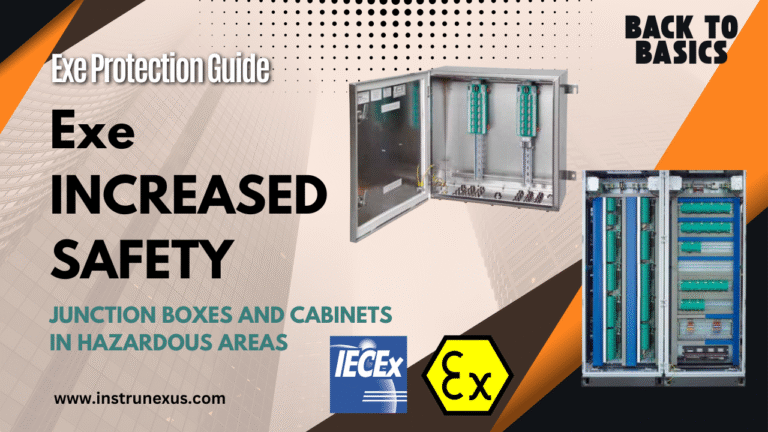
Understanding Exe Increased Safety
An interactive guide to the principles and application of 'Exe' protection for junction boxes and cabinets in hazardous areas.
This application translates the technical standards for 'Exe' protection into an accessible, interactive format. Instead of a static document, you can explore the core concepts, see how design requirements prevent ignition, and compare this method against other common types of protection to understand its specific advantages for enclosures.
Core Principles: Prevention, Not Containment
Unlike 'Exd' (flameproof) which contains an explosion, 'Exe' (Increased Safety) is designed to prevent an explosion from ever occurring. It achieves this through a set of rigorous design principles. Click each card to learn more.
No Arcs or Sparks
The primary goal is to eliminate any source of ignition during normal operation.
This is achieved using high-quality, certified terminals that are specially designed to prevent loosening under vibration or temperature changes. A loose connection can cause a spark.
It also mandates specific 'creepage' (distance over a surface) and 'clearance' (distance through air) between conductive parts to prevent arcs.
No Hot Surfaces
The equipment's surface temperature is strictly limited, even under fault conditions.
All components are selected so that their maximum possible temperature remains safely below the ignition temperature of the surrounding hazardous atmosphere.
This is defined by the 'T-Class' (T1 to T6), which we explore in the next section. An 'Exe' enclosure must have a T-rating appropriate for the environment.
Robust Enclosure
The enclosure itself must provide reliable protection against environmental factors.
A high IP (Ingress Protection) rating, typically IP54 or higher, is required to protect internal components from dust and water, which could cause shorts or corrosion.
The enclosure must also have high impact resistance (e.g., GRP, polyester, or stainless steel) to prevent cracks or damage that could compromise protection.
Key Design & Construction Requirements
'Exe' certification is not just a single feature; it's a holistic design approach. This section covers the most critical construction details that manufacturers must follow for junction boxes and cabinets.
Temperature Class (T-Rating)
The single most important safety factor is ensuring the equipment's maximum surface temperature never reaches the auto-ignition temperature of the gases or dusts present. The T-Class rating defines this limit.
The chart opposite shows the maximum temperature allowed for each class. A 'T6' rated component is suitable for the most volatile atmospheres (with low ignition points), while a 'T1' rated component is only suitable for atmospheres with high ignition points.
Ingress Protection (IP Rating)
'Exe' enclosures must prevent dust and moisture from entering, as they can lead to tracking, short circuits, or corrosion that could create a spark. A minimum rating of IP54 is typically required.
First Digit (Solids)
IP5x: Dust Protected. Ingress of dust is not entirely prevented, but it must not enter in sufficient quantity to interfere with the safe operation of the equipment.
Second Digit (Liquids)
IPx4: Splashing Water. Water splashing against the enclosure from any direction shall have no harmful effect.
Terminals & Spacing
Beyond the enclosure, the internal components are critical.
- Certified Terminals: Only 'Exe' certified terminal blocks can be used. They are designed to prevent self-loosening (e.g., using special spring or clamping mechanisms) and ensure a reliable connection that won't overheat or spark.
- Creepage & Clearance: The design must maintain strict minimum distances between conductive parts. 'Clearance' is the distance *through air*, while 'Creepage' is the distance *along a surface*. These larger distances prevent arcing, even with dust buildup or humidity.
- Impact Resistance: The enclosure must pass a high-impact test (e.g., 7 Joules) to ensure it won't crack if struck, which would compromise the IP rating and internal spacing.
How 'Exe' Compares
'Exe' is just one of many protection methods. Its suitability depends on the application. This chart compares it to 'Exd' (Flameproof) and 'Exi' (Intrinsic Safety). Use the buttons to toggle methods on and off for a clearer view.
Common Applications
Because 'Exe' is a cost-effective and easy-to-maintain method, it is extremely common for components that do not spark in normal operation. You will find it used for:
Junction Boxes
The most common use. 'Exe' enclosures with 'Exe' terminals are the standard for terminating and joining cables in hazardous areas.
Control Cabinets
Used for housing non-sparking components like switches, PLCs, and relays (which themselves may have other protection).
Light Fittings
'Exe' is used for the enclosure and lamp holder of many fluorescent and LED light fittings designed for hazardous areas.
Electric Motors
The terminal box on 'Exe' motors uses this protection method to safely connect the power supply to the motor windings.