
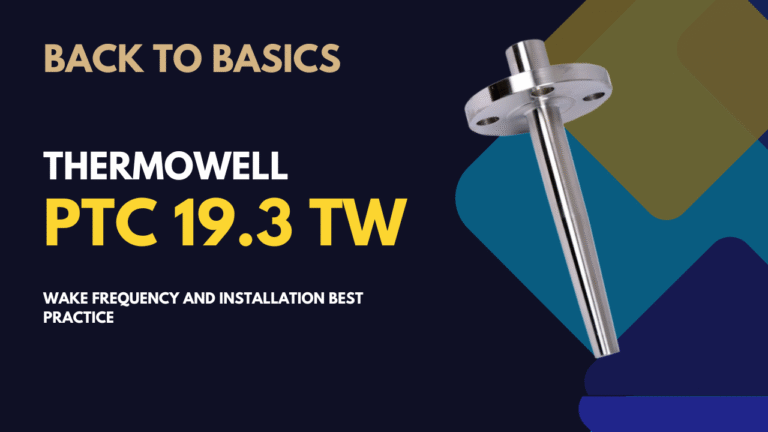
Thermowell Installation
Best Practice Codes
Explore the engineering principles behind safe temperature measurement. Understand wake frequency, immersion length, and material selection to prevent catastrophic failures.
The Physics of Failure: Vortex Shedding
The primary failure mode for thermowells is flow-induced vibration. As fluid flows past the thermowell, vortices are shed alternately from either side. This creates an oscillating force. If the frequency of this shedding (Strouhal Frequency) approaches the thermowell's natural frequency, resonance occurs, leading to fatigue failure.
Interactive Demo
Adjust the flow velocity below. Watch how higher velocities increase the shedding frequency. If the frequency gets too high (Red Zone), the thermowell vibrates dangerously.
Installation Geometry & Immersion
Correct immersion length is critical. Too short, and the reading is inaccurate due to conduction error. Too long, and the wake frequency forces may snap the stem.
Rule of Thumb: Minimum immersion should be 10x the root diameter plus the sensitive length.
Configure Installation
Wake Frequency Ratio Calculator
Codes define a strict limit for the Wake Frequency Ratio ($r_w$). This is the ratio of the wake frequency ($f_s$) to the thermowell's natural frequency ($f_n$).
- ✓ Ratio < 0.8: Generally Safe. Passed most static and dynamic stress checks.
- ! 0.8 < Ratio < 1.0: Caution Zone. Requires detailed stress analysis.
- X Ratio > 1.0: Failure Likely. Resonance imminent. Redesign required (shorten length or increase root diameter).
Quick Check Parameters
Calculated Ratio: 0.00
Status: --
Material Selection Guide
| Material | Temp Limit (°F) | Typical Application | Cost Index |
|---|